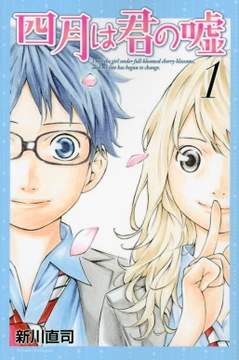
Cultural Resonance
A story that turned a single violin phrase into a million people's permission to grieve and still play on.

via Wikipedia: Rupert Sheldrake · see source
Cultural Resonance captures the way Your Lie in April (Shigatsu wa Kimi no Uso) struck a chord far beyond its immediate audience, becoming a touchstone for anyone who has wrestled with grief, perfectionism, or the fear that their art is meaningless. At its core, the story asks whether music — and by extension, any creative act — exists to impress an audience or to give the creator permission to feel. That question, framed through a piano prodigy who can no longer hear his own playing and a free-spirited violinist racing against a terminal illness, gave millions of viewers a vocabulary for emotions they had never named. The resonance is not merely emotional; it is structural. By centering a shōnen protagonist whose greatest enemy is his own self-doubt rather than an external villain, the series redefined what a coming-of-age story could say about living fully in a finite life.
- Manga author
- Naoshi Arakawa
- Anime studio
- A-1 Pictures
- Anime episode count
- 22
- Manga award
- Shogakukan Manga Award, shōnen category
- Core themes
- Grief, musical expression, mortality, joy in the present
Lore & Background
In the world of Your Lie in April, music is not background decoration; it is the nervous system of every relationship. Kōsei Arima, once a child prodigy who could sight-read and perform with mechanical precision, loses the ability to hear his own piano after his mother's sudden death. The silence is not literal — he can still hear sound — but the music stops meaning anything. He describes his playing as a recording being replayed, and the audience's applause becomes a kind of cruelty. This condition is the story's central metaphor for how grief can sever a person from their own creative identity. Kaori Miyazono enters his life like a dissonance he cannot resolve. She plays violin with visible, unapologetic joy — she laughs, she makes mistakes, she plays for the sky rather than the judges. Her philosophy is radical in a culture that equates art with mastery: music is a conversation between the player and the moment, and its value is measured in the player's heartbeat, not the audience's score. Their relationship becomes a slow negotiation between Kōsei's fear of failure and Kaori's fear of not having lived enough. When her liver illness is revealed, the stakes shift from artistic ambition to something far more elemental: whether a life cut short can still be called complete. The cultural weight of these themes is amplified by the story's refusal to offer clean resolution. Kōsei's final performance is not a triumphant victory; it is a reconciliation. He hears his own playing again, and the sound is imperfect, human, and enough. The cherry blossoms of April — the season that gives the story its title — frame this as neither pure loss nor pure renewal but both at once, which is precisely why audiences around the world saw their own complicated grief reflected back at them.
In Their Own Story
The park bench is still warm from an afternoon sun that has already begun to tilt west. Kōsei sits with his knees drawn up, the piano bench beside him empty, and listens to the echo of Kaori's last phrase hanging in the air like a thread of smoke. A breeze stirs the ginkgo leaves, and for a moment the rustle sounds almost like a sustained note — low, uncertain, resolving into nothing. He presses his palms flat against the bench slats, feeling the grain, the small roughness where the wood has split. He does not play. He does not need to. The silence, for the first time in two years, does not feel like absence. It feels like a rest between measures, the kind a conductor holds before the orchestra breathes in. Somewhere down the path, a child is practicing scales on a cheap keyboard, stumbling, laughing, trying again. Kōsei watches, and something in his chest unclenches by a single degree. He does not smile. He does not need to. He simply lets the sound reach him, and lets it be enough.
Reader's Guide
The theme of cultural resonance in Your Lie in April is most powerfully felt in the contrast between Kōsei's early recitals and his final performance. Early on, his playing is technically flawless but emotionally hollow — he describes it as a machine executing commands. The audience applauds, but he feels nothing. This mirrors a broader cultural anxiety about perfectionism in art and achievement. Kaori shatters this framework the moment she plays her violin in the park, deliberately imperfect, laughing mid-phrase, treating the instrument as a partner rather than a tool. Her philosophy — that music is for the player's own joy, not for validation — resonates with anyone who has felt trapped by external expectations. Her rooftop scenes, where she plays for no audience but the sky, become emblematic of art as pure self-expression. The story's treatment of mortality deepens this resonance. Kaori's liver illness is never played for melodrama; instead, her awareness of time's brevity makes every note feel urgent and sacred. Kōsei's final concert, where he finally hears his own playing again, transforms grief into gratitude rather than erasing it. The cherry blossoms of April — the title's namesake — frame this as a season of loss and renewal simultaneously. Beyond the screen, the series struck a nerve in a culture increasingly aware of burnout, anxiety, and the pressure to perform. Its message is not that suffering is beautiful, but that joy and sorrow are inseparable, and that art's highest purpose is to let us feel both without flinching.
Did You Know?
- The anime adaptation was produced by A-1 Pictures and consists of 22 episodes.
- The series won the Shogakukan Manga Award in the shōnen category.
- The story centers on a piano prodigy who loses the ability to hear his own playing after his mother's sudden death.
- Kaori Miyazono plays violin with visible, unapologetic joy, deliberately imperfect and laughing mid-phrase.
More in Themes & Legacy
Elsewhere in the Your Lie in April universe
Spotted an error? Know more?
This is a living reference — every entry is fact-audited, and reader corrections feed straight into our audit queue. Suggest an edit · See this site's audit record