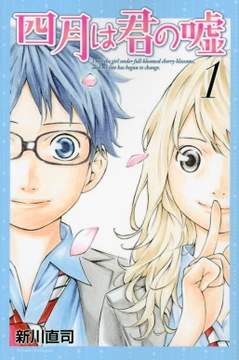
Kaori's Farewell Letter
The one truth she couldn't say aloud, sealed in ink after the last note faded.

Written during her last days, the letter is the one honest, unguarded confession she could not deliver face-to-face, and it reframes every interaction the two shared throughout the story. For Kousei—and for the reader—it is the moment the 'lie' of the title is finally peeled back, revealing the love and intentionality behind Kaori's seemingly reckless, teasing, self-destructive behavior. In the broader narrative, the letter functions as both a eulogy and a catalyst: it is the last thing Kaori gives Kousei, and it is the thing that ultimately frees him to play music not out of obligation or trauma, but out of a desire to honor the person who believed in him. It anchors the story's central theme that the words we leave behind can outlast the silence we were too afraid to break while alive.
- Manga author
- Naoshi Arakawa (not to be confused with Hiromu Arakawa, creator of Fullmetal Alchemist)
Lore & Background
Kaori Miyazono spent the bulk of the story as a force of chaotic, radiant energy—teasing Kousei, dragging him back to the violin, performing with an almost reckless joy. Beneath that performance, however, was a young woman whose hands were slowly betraying her, whose body was failing in a way she never fully named to those around her. The Farewell Letter is the single artifact where that hidden interiority surfaces in full. It is not a dramatic, tearful monologue in the way a film might stage it; it is intimate, a little scattered, very much like the way Kaori spoke to Kousei—warm, slightly teasing, but underlaid with a gravity that the reader only fully registers in hindsight. The letter's power lies in its retelling. Every moment Kousei experienced as confusion, irritation, or even resentment is recontextualized as deliberate, loving action. Kaori explains why she pushed him, why she performed when she could barely play, why she kept her condition and her feelings at arm's length. The 'lie' of the title crystallizes here: not a malicious deception, but the kind of lie people tell to protect someone else from the weight of their pain. By reading it, Kousei is forced to grieve not just the loss of Kaori, but the loss of the version of her he thought he understood. Musically, the letter sits at the intersection of every performance Kaori gave. Her final recital, her duets with Kousei, her whispered encouragement in practice rooms—all of it gains a new harmonic layer once the letter's words are known. The piano, which was her identity and her prison, becomes in the letter's context a language of love she was trying to speak in a key no one else could hear.
In Their Own Story
The apartment is quiet in the way only a Tuesday afternoon in late autumn can be. Kousei sits on the edge of his bed, the violin case open and empty beside him, a single sheet of paper folded into a small square in his palm. The handwriting is hers—slightly slanted, the loops of the 'k's a little too large, the way she always wrote when she was trying to be casual. He has read it twice. He is reading it a third time, though he knows the words will not change. Outside, the wind stirs the maple leaves against the window glass. Somewhere down the street, a neighbor's child is practicing scales on an upright piano, the notes clumsy and uneven. Kousei listens. For the first time in months, the sound does not make his hands ache. It makes him think of a girl who used to play Chopin with her eyes closed and her hair falling over her face, who would stop mid-phrase to grin at him as if the music were a joke only they understood. He folds the letter back into its square. He does not put it away. He sets it on the windowsill where the late light will hit it, and he picks up his bow. The first note is thin, uncertain. The second one is not.
Reader's Guide
She withdraws from performance, and Kousei, still haunted by his own inability to play after his mother's death, is the only person who notices the silence where music used to be. This sets up the emotional stakes: both characters are defined by what they can no longer do, and their bond begins in mutual recognition of loss rather than in romance. To Kousei, this feels like cruelty or manipulation. The reader senses, but does not yet confirm, that Kaori's urgency is tied to her own dwindling time. Musically, this arc is marked by Kousei's first public performances and his duets with Kaori—moments of fragile, unpolished beauty that contrast with the technical perfection of his earlier, mechanical playing. She stops playing entirely. The final recital she gives is short, imperfect, and devastating—she plays not for the audience but for Kousei, who is in the hall. This is the last musical milestone before the letter, and it is the performance she most wanted him to remember. The relationship shifts from playful antagonism to a quiet, aching tenderness that neither character names aloud. Arc 4 – The Letter (climax): Kaori dies. Kousei reads her letter. Every prior interaction is recontextualized. The 'lie' is revealed as an act of love. Kousei is left with the letter as his only remaining connection to her, and the story's final movement—his eventual return to playing, his decision to perform publicly—is framed as an answer to the letter's central question: will you play for yourself, or for the person who believed you could? The letter reshapes Kousei's relationship with music from obligation to gratitude, and his relationship with the world from isolation to participation.
Did You Know?
- The manga was written and illustrated by Naoshi Arakawa—no relation to Hiromu Arakawa of Fullmetal Alchemist fame—giving the story a distinctive blend of emotional intimacy and visual warmth.
- Kaori's medical condition is never explicitly named in the manga; it is only described as a serious illness, leaving the exact nature of her decline ambiguous and focused on its emotional impact rather than a specific di
- The title 'Shigatsu wa Kimi no Uso' (Your Lie in April) is of
More in Story & Timeline
Elsewhere in the Your Lie in April universe
Spotted an error? Know more?
This is a living reference — every entry is fact-audited, and reader corrections feed straight into our audit queue. Suggest an edit · See this site's audit record