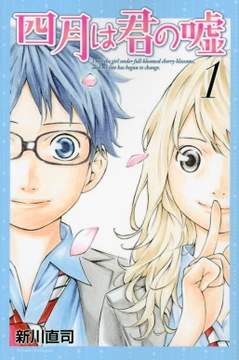
Kaori Miyazono's violin
A violin that plays not to be heard, but to be felt—and changes everyone who listens.

Kaori Miyazono's violin is the beating heart of *Your Lie in April*—the instrument through which her wild, unbridled passion for music first reaches Kousei Arima and, through him, the audience. It is not merely a prop but a character in its own right: a vessel for the kind of playing that ignores technical perfection in favor of raw, aching emotion, and a symbol that outlives its owner. In a story where a pianist has lost the ability to hear his own playing, this violin becomes the sound that cracks open a sealed world. Every bow stroke Kaori draws across the strings carries the weight of a girl who plays not to win but to feel, and the instrument's presence—first in the bright chaos of a public performance, later in the quiet grief of its absence—frames the emotional architecture of the entire narrative.
- Character
- Kaori Miyazono
- Role
- Violinist; catalyst who reawakens Kousei's relationship with music
- Affiliation
- High school student (same school as Kousei Arima)
- Instrument
- Violin (played with a free, improvisatory style)
- Playing style
- Emotion-driven, unconventional, prioritizes expression over technical rigidity
- Status
- Deceased (dies from a terminal illness mid-story)
- Narrative function
- Central symbol of musical freedom and the cost of living fully
Lore & Background
In the rigid, competition-driven world of classical music that *Your Lie in April* inhabits, Kaori's violin is an act of rebellion. Where other players chase flawless intonation and metronomic precision, Kaori draws the bow as though the strings were a river she is wading through—sometimes rushing, sometimes still, always alive. Her playing is described in the narrative as free, almost feral, a style that earns both admiration and confusion from those trained in the orthodox tradition. The violin, in her hands, refuses to be a machine for producing correct notes; it is a voice, and an impatient one at that. The instrument's significance deepens because of who it belongs to. Kaori is a girl who lives at full volume, who laughs too loud, who treats every day as though it might be borrowed. The violin is her way of saying that music is not a performance to be judged but a conversation to be had. When she plays, the audience does not sit in polite silence; they are *moved*, sometimes to the point of discomfort, because what they hear is not a recital but a confession. After Kaori's death, the violin becomes a relic. It sits in a case, silent, a physical reminder that the sound it once made is gone forever. Yet the story insists that the music did not die with her. Kousei, who once could not hear his own piano, eventually plays again—and what he plays is shaped, inescapably, by the ghost of that bow on those strings. The violin's absence is felt more powerfully than its presence ever was, and it is in that silence that the audience understands what Kaori was trying to say all along: that the most honest music is the kind you play while you still can.
In Their Own Story
The afternoon light through the recital hall windows turns the dust motes into slow gold. Kaori lifts the violin to her chin with the casual ease of someone picking up a coffee cup, and the first note she draws is not the one the audience expects. It is lower, rougher, a sound like a cello's whisper trapped in a smaller body. The judges shift in their seats. The audience leans forward. She does not play the piece as written. She plays it as *lived*—stretching phrases, letting them breathe, letting them fall. A trill becomes a sob. A cadence becomes a door slamming. By the final bar, the hall is so quiet you can hear the rosin dust settling on the stage floor. No one claps. No one needs to. The silence that follows is louder than any ovation, and in the third row, a boy with a piano bench's worth of silence inside him hears, for the first time in years, a sound that is not a test. It is a hand, reaching.
Reader's Guide
Kaori's violin performances function as set-pieces that reframe the story's emotional stakes each time the bow touches the strings. The first public playing—casual, almost reckless, in a setting that is not a formal stage—establishes the contrast. Where the world around Kousei is measured, scored, and judged, Kaori plays as though the audience is a single person she is talking to. The technical execution is there, but it is *subordinate* to expression. The stakes are personal: she is not performing for a grade. She is saying *I am here, and I am not afraid.*
The recital performance raises the temperature. Now there is a program, an expectation, a room full of people who know what a violin should sound like. Kaori plays into that expectation and then walks around it. The audience's reaction is the turning point: confusion gives way to recognition, and recognition gives way to something almost painful. This is the moment the story tells you that music is not a competition. It is a risk. And then there is the absence. The violin in its case, the empty chair, the silence where a melody should be. The final "performance" is the one Kousei gives without her, playing piano in a way that carries the shape of her bowing. The audience remembers not the notes but the feeling, and that is why the violin lingers: it was never about the instrument. It was about the girl who made it sound like a heartbeat.
Did You Know?
- Kaori's playing style is deliberately positioned against the 'perfect' classical ideal in the story; her value lies in emotional truth rather than technical flawlessness, and the narrative treats both as valid but distin
- The violin serves as a narrative device to reawaken Kousei's ability to *hear* his own piano—a sensory and emotional blockage that defines the first half of the story.
- After Kaori's death, the violin's silence becomes as narratively significant as its sound; the story uses the absence of the instrument to mark the emotional turning point for the protagonist.
- Kaori's free, improvisatory approach to a written piece is a recurring motif: the story repeatedly shows that the *feeling* behind the notes matters more to the characters (and the audience) than strict adherence to the
More in Music & Performances
Elsewhere in the Your Lie in April universe
Spotted an error? Know more?
This is a living reference — every entry is fact-audited, and reader corrections feed straight into our audit queue. Suggest an edit · See this site's audit record