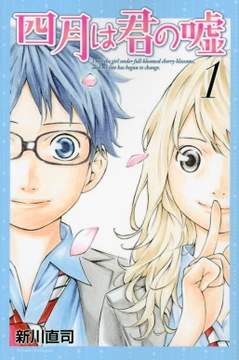
Kaori's spiccato bowing technique
Every bounce of the bow is a heartbeat Kaori refuses to hide.

Spiccato is a bowed-string technique in which the bow bounces lightly off the strings, producing a series of short, articulate, springy notes. In the world of *Your Lie in April*, it lives inside the broader vocabulary of Kaori Miyazono's violin playing—a style the series paints as fiercely personal, emotionally unfiltered, and deliberately unbound by the rigid technical perfectionism of her academy peers. Rather than presenting spiccato as a cold exercise in control, the narrative folds it into Kaori's signature approach: every articulation, every bounce of the bow, becomes a breath, a pulse, a small act of defiance against silence. Within the story, Kaori's relationship to technique—spiccato included—is never purely mechanical. It is the vehicle through which she makes Kousei Arima hear music again, through which she asserts that playing is about feeling rather than winning. The technique matters to the audience not because of its physics but because of what Kaori's hands and heart do with it in the moments that define the series.
- character
- Kaori Miyazono
- instrument
- Violin
- role
- Deuteragonist / co-lead
- technique_category
- Bowed articulation (spiccato)
- affiliation
- Music academy student (ensemble member)
- ensemble_instruments
- Violin, cello, piano, drums
- status
- Deceased (in-story)
Lore & Background
Kaori Miyazono enters the story as a violinist who treats the instrument less like a competition tool and more like a conversation partner. Where her academy classmates are trained to produce flawless, competition-ready sound, Kaori plays with a looseness that borders on recklessness—slightly behind the beat, slightly louder than expected, always chasing the feeling behind the note. Spiccato, in her hands, is not the metronomic, even-bounce exercise a conservatory instructor might drill; it is a staccato of emotion, a rapid-fire string of small decisions that say *I am here, I am alive, I am choosing this note right now.*
The series frames this philosophy as a direct challenge to Kousei Arima, a pianist who once played with similar fire but was shattered by a loss and the pressure of his late father's expectations. Kaori's spiccato passages—bright, bouncy, almost playful—contrast sharply with the austere, technically immaculate performances he once idolized. For the audience, the technique becomes a metaphor: music is not a monument to be preserved but a living pulse, and a single bouncing bow-stroke can carry more truth than a perfectly sustained tone. As the story progresses and Kaori's health quietly deteriorates, her playing takes on an added layer of urgency. The same spiccato that once sounded like carefree joy now reads as someone racing against time, squeezing every bright, bouncing note out of the present moment before it is gone. The audience is left to feel the weight of that contrast long after the final note fades.
In Their Own Story
The practice room smells of rosin and old wood. Afternoon light slices through the blinds in pale gold bars, and Kaori sits cross-legged on the bench, chin rest already warm against her jaw. She doesn't open her eyes. She just lifts the bow, lets it kiss the A-string, and lets it spring. One bounce. Two. Three. The notes scatter like small bells dropped on a tile floor. She grins, tilts her head, and does it again—faster this time, the bow leaping, the strings answering in quick silver stabs. Somewhere down the hall a metronome ticks its indifferent rhythm, but in here the only clock is her breath. She stops, sets the bow down, and laughs at herself. "Too much?" she asks the empty room. The room, of course, says nothing. She picks the bow back up and plays the phrase one more time, softer, as if whispering a secret to the strings. Then she turns off the light and leaves the violin in the case, the last faint vibration still trembling in the air.
Reader's Guide
Think of Kaori's spiccato passages as the series' emotional punctuation marks. They appear in her solo and ensemble moments—across academy recitals, the small informal jam sessions with Aimi, Tsubaki, and Ryota, and the larger concert settings that anchor the story's turning points. The stakes are never just technical; they are relational. When Kaori bounces her bow in a public hall, she is simultaneously performing for judges, for her friends, and for Kousei, who is listening from the audience with the particular vulnerability of someone learning to trust his own ears again. The technical element is the contrast: spiccato demands a light, controlled contact point, yet Kaori's execution carries a slight, deliberate irregularity. The bounces are not perfectly even. They breathe. That imperfection is the point. It signals to the audience that this is a human choosing to play, not a machine reproducing a recording. Emotionally, these moments mark shifts—Kaori inviting Kousei into an ensemble, the group finding a groove together, or Kaori playing with a brightness that the audience, knowing her condition, reads as bittersweet. What lingers is the sensory memory: the quick, bright, almost percussive texture of the notes cutting through the sustained cello and piano, the way the phrase resolves not into silence but into a held, ringing tone that seems to hang in the concert-hall air a beat longer than it should. The audience remembers the sound because it was never just sound. It was Kaori saying, without words, that the music is still alive and so is she, at least for this phrase.
Did You Know?
- Kaori's playing style is consistently framed in the series as an emotional and philosophical counterpoint to the rigid, competition-driven culture of her music academy, making every technical choice—including articulatio
- Her ensemble features a distinctive four-instrument lineup (violin, cello, piano, drums) that is unconventional for a classical setting, reinforcing the story's theme of music as personal expression rather than genre-pur
- Kaori's physical health is a quiet, persistent undercurrent in the narrative; her increasingly urgent and vivid playing is understood by the audience as someone making the most of limited time, which reframes even bright
- The series deliberately avoids depicting music as a competition to be won; Kaori's relationship to technique, including articulation exercises, is always filtered through the question of how the music makes the player an
More in Music & Performances
Elsewhere in the Your Lie in April universe
Spotted an error? Know more?
This is a living reference — every entry is fact-audited, and reader corrections feed straight into our audit queue. Suggest an edit · See this site's audit record